EchoPath
Walks with you.
Tells no one.
EchoPath is a pair of glasses that turns the street into touch. Three vibration channels: left, front, right. Silent by default. Built for people who are blind.
Every device is donated.
The problem
Every assistive device announces its user: the cane taps, the app narrates, the sensor beeps. By the time a blind person says hello, the room already knows.
EchoPath moves that information to the skin, where it belongs to its owner.
The film
The future we refuse to build.
One minute of fiction. EchoPath in 2030, imagined as the eyes of a national perception network: every street mapped, every routine recorded, every person a profile to be bought, sold, or stolen.
The walk
This scene is silent, like the product.
- You are the walker. Your scroll is your pace, and the street comes to you. Three sensing channels face forward: left, front, right.
- A parked scooter drifts into the left channel. Two soft taps land at the left temple, then stop. The wearer knows. The street hears nothing.
- A person crosses ahead. The front channel quickens as they near, because risk is scored by distance, movement, and direction. For a truly urgent hazard, EchoPath speaks once, briefly. Everything else stays touch.
- A curb edge on the right. One firm tap, and quiet again.
- For most of the walk, nothing fires at all. Quiet means safe. That is the design.
- 94 steps. Zero sounds. Nobody on that street knows what the glasses just did, which is the entire point.
Under 300ms camera to skinAll inference on device.
The walk
This scene is silent, like the product.
Motion is off, per your system setting. Here is the same walk, one frame of it, and every step of what the wearer feels:
- You are the walker. Your scroll is your pace, and the street comes to you. Three sensing channels face forward: left, front, right.
- A parked scooter drifts into the left channel. Two soft taps land at the left temple, then stop. The wearer knows. The street hears nothing.
- A person crosses ahead. The front channel quickens as they near, because risk is scored by distance, movement, and direction. For a truly urgent hazard, EchoPath speaks once, briefly. Everything else stays touch.
- A curb edge on the right. One firm tap, and quiet again.
- For most of the walk, nothing fires at all. Quiet means safe. That is the design.
- 94 steps. Zero sounds. Nobody on that street knows what the glasses just did, which is the entire point.
Under 300ms camera to skinAll inference on device.
The haptic language
220 degrees of coverage. Hundreds of micro motors in three channels. One rule: you only feel what matters.
Cadence follows risk
A hazard drifting closer on the left makes the left channel tick faster. Hundreds of micro motors blend the pulse onto its exact bearing, so the wearer feels where, precisely, and how urgent.
Most things never fire
People passing by, parked cars, anything not on a collision path stays below the hazard threshold and produces nothing at all. EchoPath does not bug its wearer.
Voice, only at the edge
Only when impact looks likely does EchoPath speak, once and briefly. Everything below that line stays touch, and everything below the threshold stays silence.
Live loop. Nothing here makes a sound.
Feel it
Each channel has its own rhythm. On a phone that allows it, these buttons play the real ones.
The hardware. Real footage, no renders.
The object
A camera, hundreds of micro motors, and a voice it almost never uses.
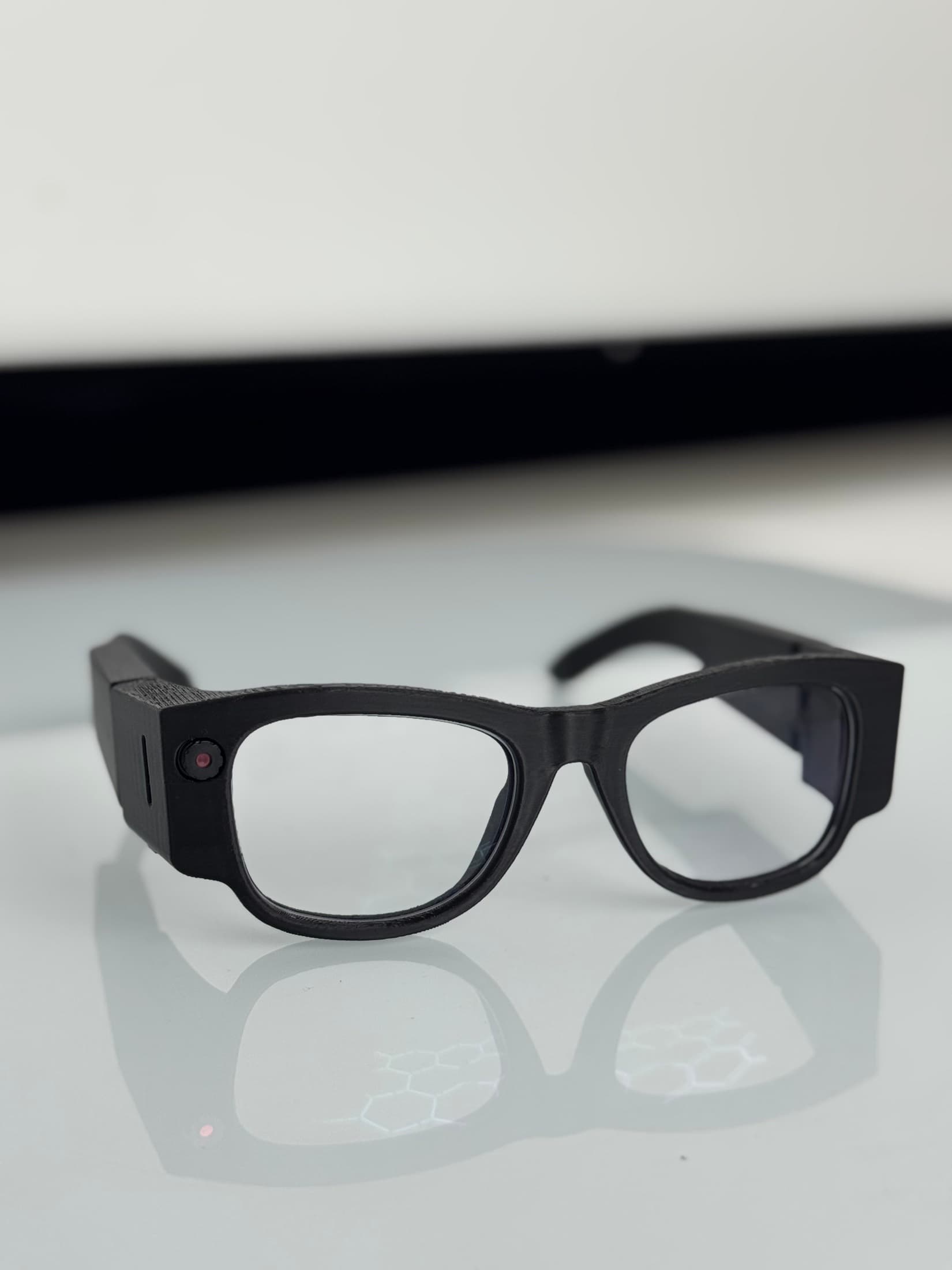
Every unit is built by hand and delivered to Vista Center in person. The frame holds a camera that scores risk by distance, movement, and direction, and hundreds of micro vibration motors grouped into three channels: left, front, right. They fire in precise blends, so touch can point at a hazard instead of just tapping near it. When something is truly urgent, a brief voice alert cuts in, once, then the silence comes back.
- Under 300ms
- Camera to skin. Measured, not estimated.
- 8 hour battery
- A full day of walking on one charge.
- On device
- Inference runs on the glasses, not a server.
- No facial recognition
- It reads distance and motion, never identity.
- No retention
- No video is stored by default.
- Reaches out when it matters
- Emergency contact calling, and check in texts with location for caregivers.
The proof
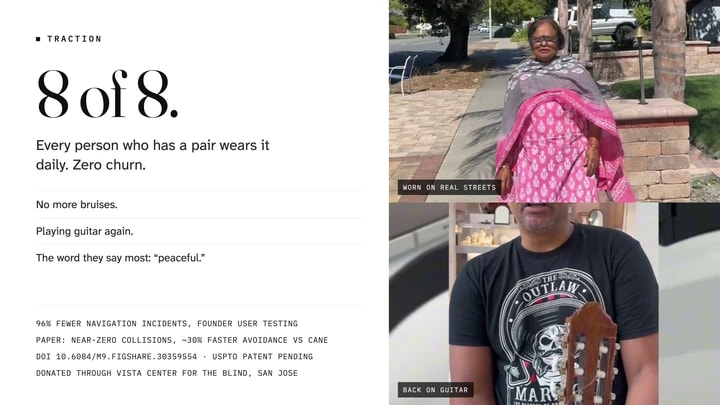
Real pairs are out in the world, at Vista Center for the Blind in San Jose.
In user testing, navigation incidents nearly disappeared.
Every device is donated. Nobody has ever paid for one.
People wear them daily, on real streets.
Observed in the Vista Center deployment and user testing.
The builder
Why this exists.
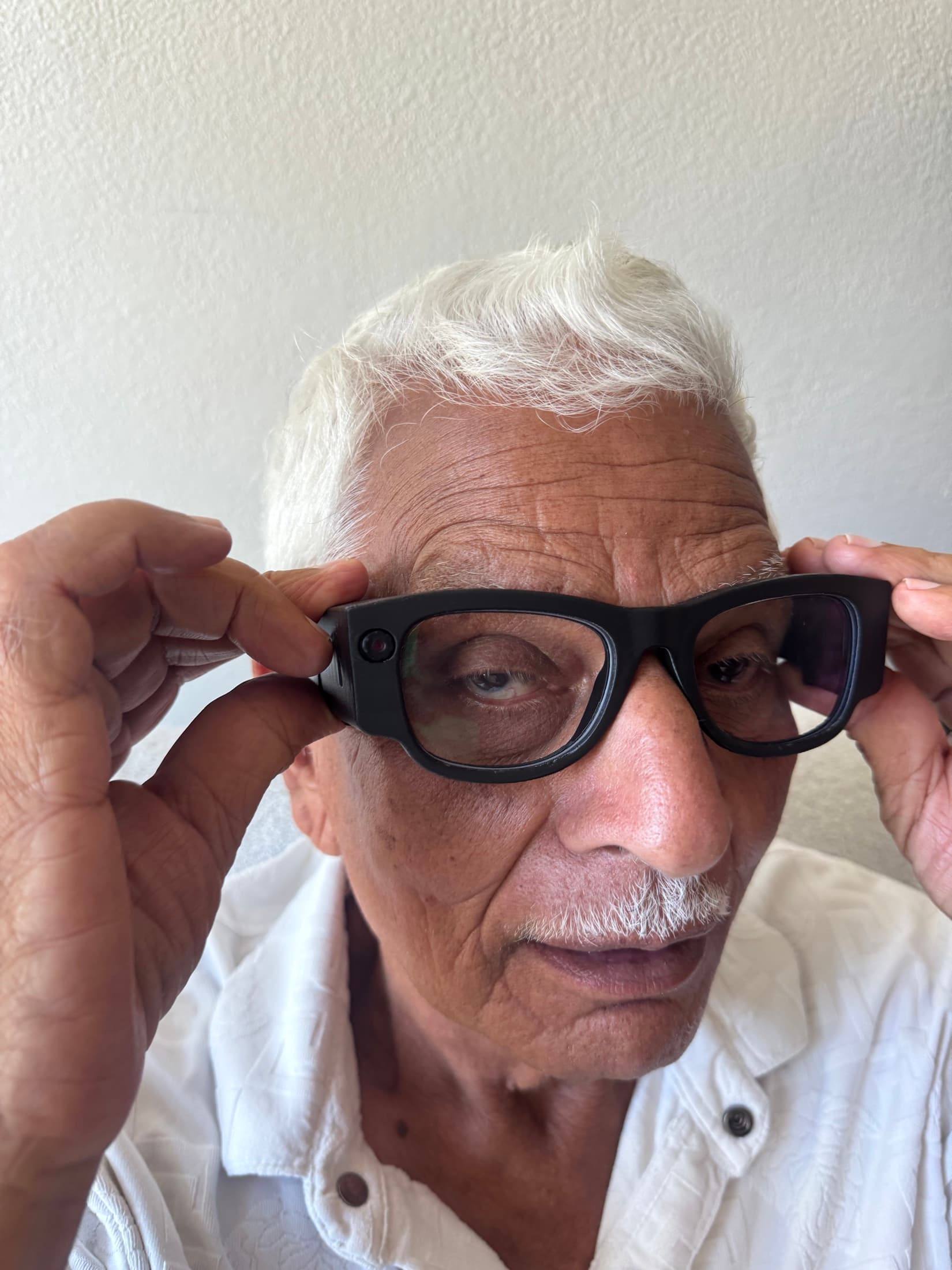
EchoPath began inside an ELC venture challenge and refused to stay a class project. Kartik builds each device by hand and brings it to Vista Center, where people walk with them every day.
There is one rule that will not change: nobody who needs one pays for it.
The pitch
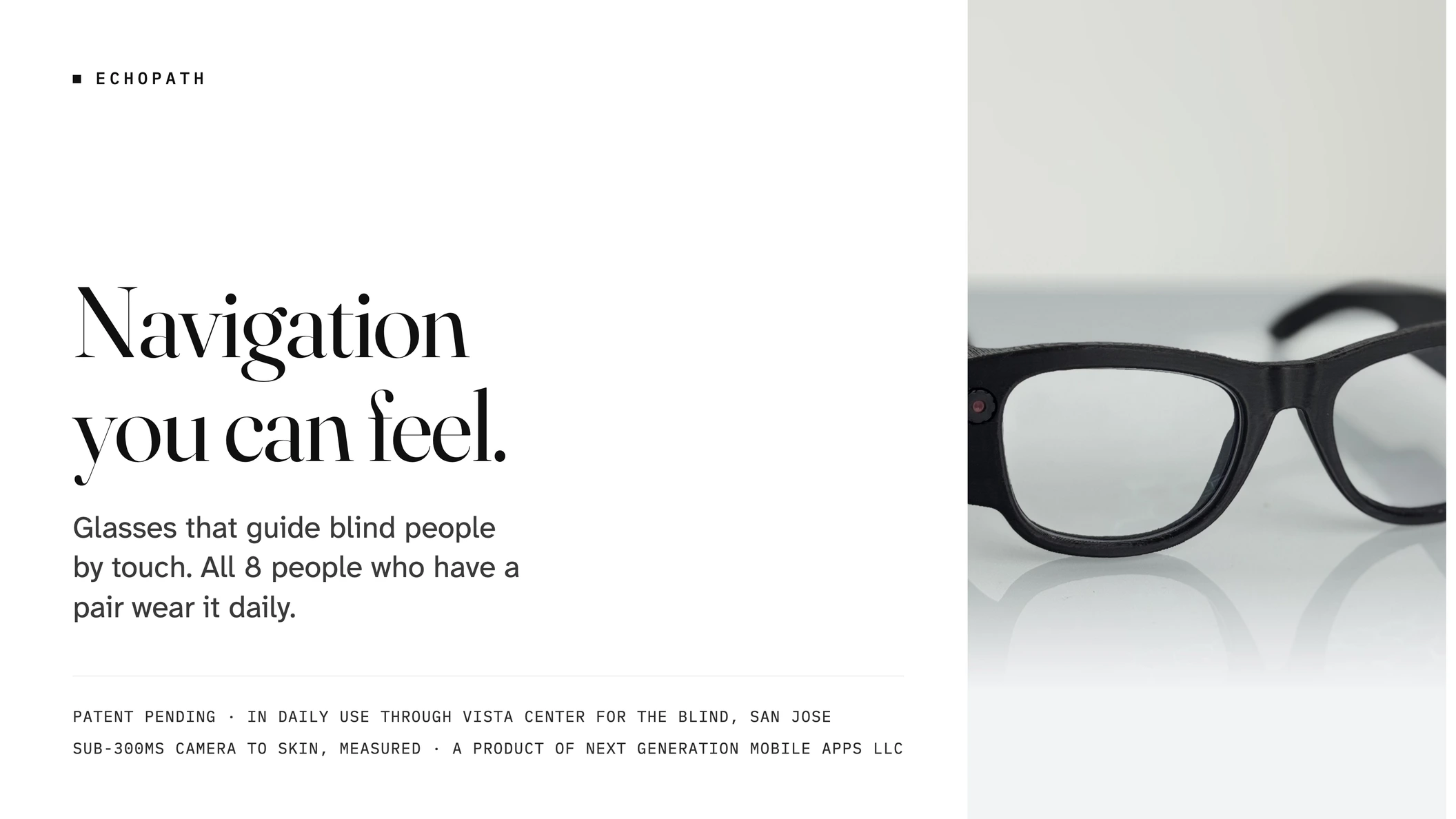
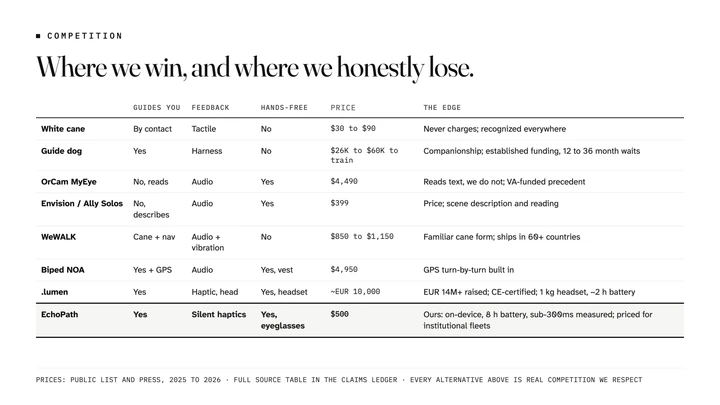
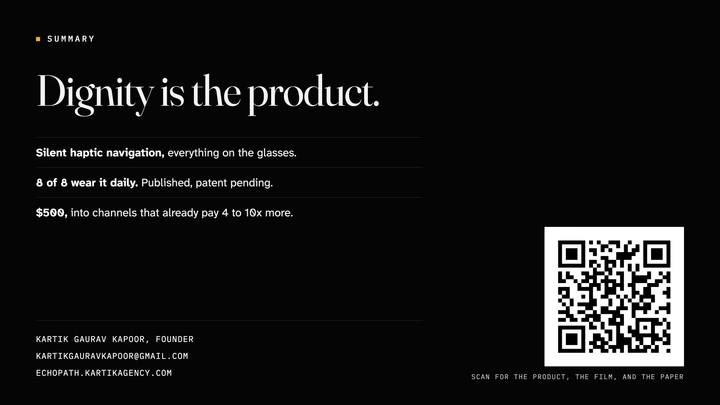
The 13-slide deck we took to Startup World Cup East Bay 2026.
Every number sourced on the slide. Every assumption printed.
The request
Tell us about someone you love.
Every EchoPath is donated. Nobody pays. They are built in small batches and supply is limited, so we cannot promise a timeline, and we will not pretend otherwise. What we can promise: the story you write below is the first thing that gets read.